smv calculation garments
Textile Calculation Guide: SMV, Line Efficiency and Garment Production (Complete IE Guide 2026)
In garment and textile operations, accurate Industrial Engineering (IE) calculations drive output, cost control, and delivery reliability. This guide explains SMV, SAM, line efficiency, production capacity, and operator target formulas with practical examples you can apply on the factory floor.
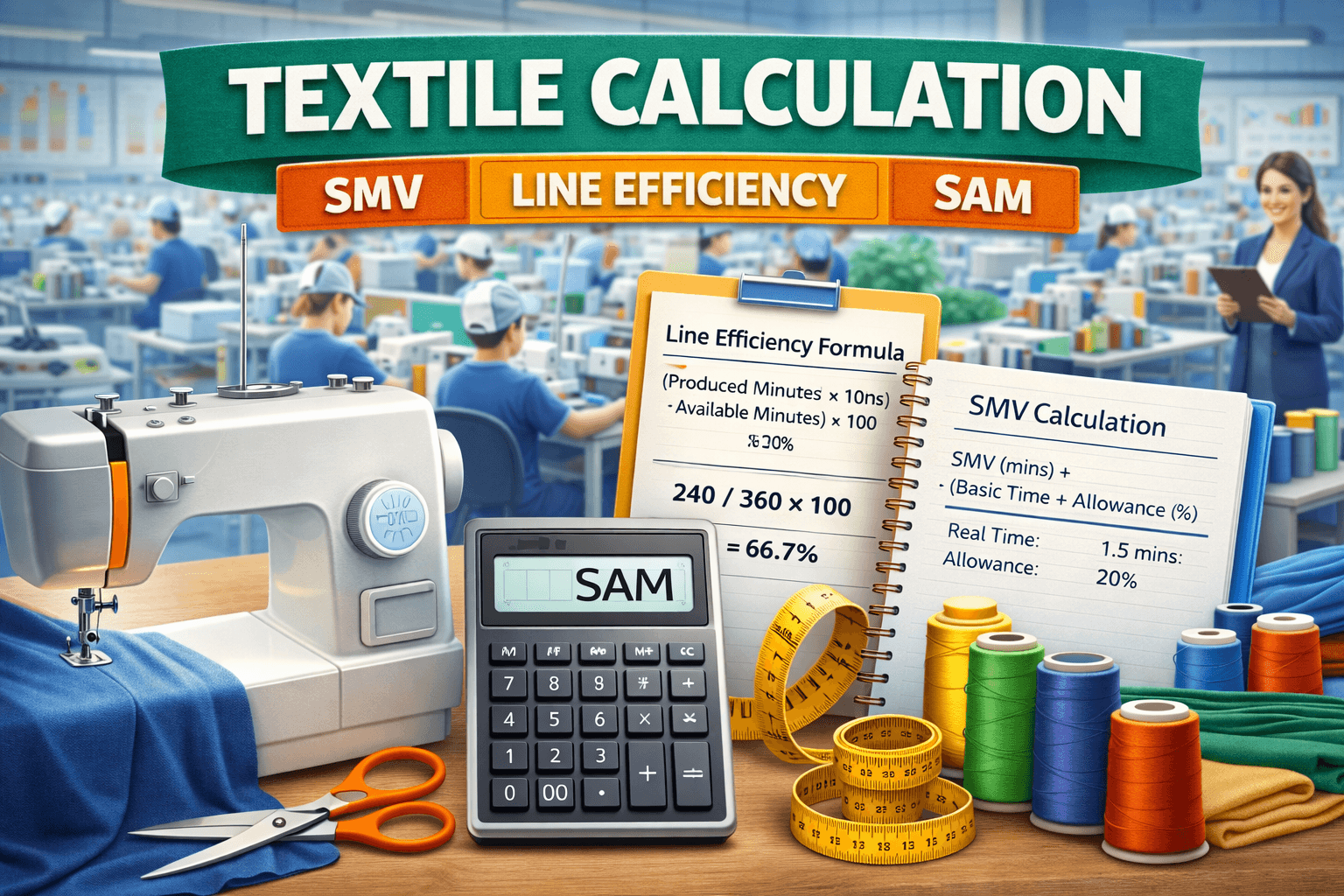
Bangladesh-focused guide with practical calculation workflow.
What Is SMV (Standard Minute Value)?
- SMV is the standard time required to complete one operation under defined working conditions.
- SMV is a core IE metric used for costing, planning, and target setting.
- A more accurate SMV improves production planning and line loading decisions.
SMV Formula
- SMV = Basic Time + Allowance.
- Equivalent form: SMV = Basic Time x (1 + Allowance%).
- Basic Time is observed operation time; allowance covers fatigue, delays, and unavoidable interruptions.
SMV Example
- Operation time = 1.5 minutes, allowance = 20%.
- SMV = 1.5 + (1.5 x 20%) = 1.5 + 0.3 = 1.8 minutes.
- Pieces per hour estimate from SMV: 60 / 1.8 = 33.3 pcs/hour (before efficiency adjustment).
Why SMV Matters
- Production planning and order loading.
- CM/cost estimation and pricing control.
- Operator target setting and line balancing.
- Performance tracking across styles and lines.
What Is SAM (Standard Allowed Minute)?
- SAM is commonly used interchangeably with SMV in many garment factories.
- In practical use, SAM represents the standard allowed time per unit.
- Always align internal terminology so IE, planning, and production teams use one consistent definition.
Line Efficiency Formula
- Line Efficiency (%) = (Produced Minutes / Available Minutes) x 100.
- Produced Minutes = Total Output x SMV.
- Available Minutes = Number of Workers x Working Minutes.
Line Efficiency Example
- Workers = 20, working time = 8 hours (480 minutes), output = 4,000 pcs, SMV = 1.5.
- Produced Minutes = 4,000 x 1.5 = 6,000.
- Available Minutes = 20 x 480 = 9,600.
- Efficiency = (6,000 / 9,600) x 100 = 62.5%.
Production Capacity Formula
- Production = (Total Minutes x Efficiency) / SMV.
- Use efficiency as decimal in formula (for example 70% = 0.70).
- This gives theoretical output capacity for selected inputs.
Production Capacity Example
- Available minutes = 9,600, efficiency = 70%, SMV = 1.5.
- Production = (9,600 x 0.70) / 1.5 = 4,480 pcs/day.
- Capacity changes immediately with SMV, manpower, or efficiency shifts.
Operator Target Formula
- Target (pcs) = Available Minutes / SMV.
- Example: 480 minutes and SMV 1.5 -> target = 480 / 1.5 = 320 pcs/day.
- For realistic target setting, apply planned efficiency and skill factors.
Line Balancing and Bottlenecks
- Line balancing distributes work content to minimize idle time and bottlenecks.
- Better balance increases flow consistency and stabilizes line output.
- Track bottleneck operation time, workstation load, and WIP buildup regularly.
Key Textile Calculation Summary
- SMV = Basic Time + Allowance.
- Efficiency = (Produced Minutes / Available Minutes) x 100.
- Production = (Minutes x Efficiency) / SMV.
- Target = Minutes / SMV.
Common IE Calculation Mistakes
- Using wrong or outdated SMV for style changes.
- Ignoring allowance or using inconsistent allowance assumptions.
- Mixing minutes and hours in efficiency calculations.
- Poor line balancing and no bottleneck follow-up.
How to Improve Line Efficiency
- Train operators on critical operations.
- Reduce idle time with better input/output control.
- Improve machine maintenance and changeover discipline.
- Optimize operation sequence and workstation layout.
- Use IE tools for daily root-cause based improvement.
Related Calculators and SEO Keywords
- Related calculators: SMV Calculator, SAM Calculator, Line Efficiency Calculator, Production Capacity Calculator, ROI Calculator, and Profit Margin Calculator.
- SEO keywords: smv calculation garments, line efficiency calculation, garment production formula, ie calculation textile, sam calculation, production capacity garments.
Final Thoughts
- Textile IE calculations are the backbone of predictable garment production.
- Mastering SMV, efficiency, and production formulas helps increase output and reduce cost.
- Use calculator-based workflows to standardize decision-making across planning and production teams.